

『Palm Oil Flow Meter 100 L/h Small Line Diagnostic Benchmarks』Related information(clamp on meter|electromagnetic meter|venturi meterrotameter|orifice meter|ultrasonic flow meter|mass flow meter|coriolis mass flow meter|coriolis flow meter|magnetic flow meter|magmeter flow meter|magflow flow meter|mag meter flow meter|electromagnetic flow meter|vortex flow meter|turbine flow meter|thermal mass flow meter|thermal flow meter|rotameter flow meter)
Palm Oil Flow Meter 100 L/h Small Line Diagnostic Benchmarks
Quick Answer: For palm oil at 100 L/h in a small pipe, a Coriolis mass flow meter with onboard diagnostics gives you density, mass flow, and real-time tube health. The Silver Instruments SLG series with DN08 or DN10 is a proven match. Expect a repeatability of ±0.05% and zero stability below 0.2 kg/h after a 30‑minute warm‑up.
Palm oil applications often run on tight lines. Pipe sizes fall between DN08 and DN15. A 100 L/h flow is routine for a dosing skid or a small transfer line in a refinery in Indonesia or Malaysia. At this rate, traditional meters struggle because the fluid viscosity changes with temperature. Palm oil can sit at 35 cP at 50 °C or climb past 50 cP if the trace heating drops. That shift alone throws volumetric meters off by 2% to 5% if no live correction is in place.
We hear this from plant engineers across Southeast Asia. A customer in Johor ran an oval gear meter on a 15 mm line and saw a 3% drift between morning and afternoon batches. The root cause was not the meter hardware. It was the missing density input. Without it, the PLC had to assume a fixed kg/L value. A Coriolis meter from Silver Instruments removed that assumption. It delivered mass flow directly, plus a live density reading at 0.5 g/L resolution. The batch weight error dropped from ±1.5 kg to ±0.15 kg on a 200 kg target.
Why Benchmark Diagnostics on a 100 L/h Palm Oil Line
Diagnostics are not just for large custody transfer points. On a small line, a partial blockage, an air slug, or a bit of coating can push the reading outside your quality tolerance. With 100 L/h, even a 0.5 L/h zero shift becomes 0.5% of rate. That hurts product consistency.
Silver Instruments Coriolis meters include a diagnostic suite that monitors drive gain, pickoff voltage, and tube frequency. These values form a fingerprint of a healthy meter. We call this the baseline. When you record values during the first clean run, you get numbers you can compare later. A drive gain above 15% on a DN10 sensor at 100 L/h palm oil usually signals gas pockets or thick coating. In practice, most engineers set an alarm at 12% and clean the meter if it stays high for more than five minutes.
Here is a typical baseline for a DN10 Coriolis on palm oil at 100 L/h and 55 °C:
Mass flow rate: 100 L/h (approx. 89 kg/h at 0.89 kg/L)
Drive gain: 6% to 8%
Pickoff voltage: 1.2 V to 1.5 V
Tube frequency: 102 Hz ±0.1 Hz
Density: 0.890 kg/L ±0.002
Temperature: 55 °C ±0.2 °C
Zero stability: <0.15 kg/h
Any sustained deviation outside these windows triggers a maintenance check. We have seen sites in Thailand run the same baseline for six months without a single false alarm. That kind of confidence lets you schedule cleaning around production downtime, not after a batch failure.
Picking the Right Meter for 100 L/h Palm Oil
You can choose between an oval gear meter with a PT100 and a flow computer, or a Coriolis meter that does the math inside the sensor. For 100 L/h, an oval gear meter sized for 0.5 to 5 L/min works if you keep the oil above 50 °C and free of solids. But palm oil often carries traces of filter aid or fibre. Those particles can jam the gears. The maintenance team then has to open the chamber every few weeks.
A Coriolis meter from Silver Instruments has no moving parts in the flow path. Our SLG‑DN10 model handles 0 to 200 kg/h with a wetted 316L stainless steel tube. The process connection is ½ inch Tri‑Clamp or ¼ inch NPT. It outputs mass flow, volume flow, density, and temperature over 4‑20 mA HART and Modbus RTU. In a project for a margarine plant in Nigeria, the customer replaced two oval gear meters with one SLG‑DN10 and cut monthly maintenance hours by 60%.
If you need a lower-cost option, our oval gear flow meter with a local display and pulse output can work. Add a separate density meter or take a sample once a day to correct volume to mass. But that setup adds manual steps. Most sites that run 100 L/h on a continuous basis go straight to Coriolis because the diagnostic data alone prevents batch loss. Ask your instrument team: how much does one off‑spec batch cost? That number often pays for the meter within a year.
Setting Up the Baseline: A Practical Walkthrough
We do this on customer sites often. The
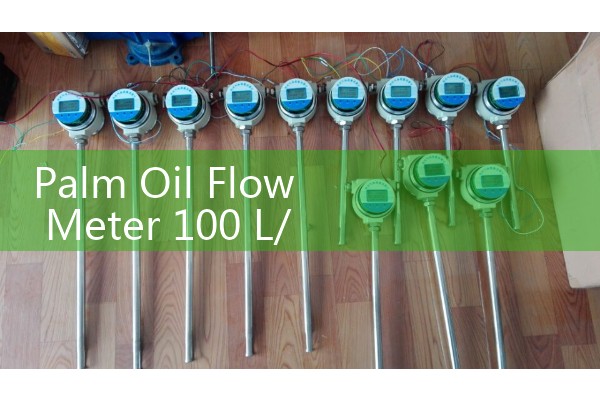
First, flush the line with hot water or a cleaning solution to remove air and residues. Then fill the system with palm oil at the normal process temperature. Leave the line at zero flow for 30 minutes. During this time, the meter warms up and the zero stability settles. Record the zero value. On a DN10, expect less than 0.2 kg/h drift. If you see 0.5 kg/h or more, there is a small leak, trapped gas, or a two‑phase flow condition.
Second, start the pump and set the flow to 100 L/h. Wait until the density reading stabilizes. This takes five to ten minutes because the tube must reach thermal equilibrium. Capture the baseline drive gain, pickoff voltage, tube frequency, density, and temperature. Export the values to your DCS or save them in a log.
Third, run a high‑flow point. Push to 150 L/h for two minutes and back to 100 L/h. The diagnostic values should return to the baseline within 30 seconds. A slow return hints at coating buildup. A viscosity test of the palm oil sample will confirm.
Repeat this baseline every time you change the oil source or after a major cleaning. The numbers become your early warning system. Because the diagnostic benchmarks are tied to the process fluid, they detect problems that a simple flow totalizer cannot.
Common Mistakes and How to Avoid Them
One mistake is installing the meter after a 90‑degree elbow with less than 10 pipe diameters of straight run. For a DN10 Coriolis, you need only a short inlet section, about 5D, because the meter is insensitive to flow profile. But on oval gear meters, straight run matters more. Always follow the ISO 5167 recommendation for the meter type you use.
Another mistake is ignoring the back pressure. Palm oil at 100 L/h can create a pressure drop of 0.2 to 0.4 bar across a DN10 Coriolis. If the downstream vessel is open to atmosphere and the oil is close to its bubble point, you might get cavitation. Keep at least 0.5 bar back pressure on the meter outlet.
Third mistake is using the wrong gasket material. Palm oil attacks EPDM over time. Use Viton or PTFE gaskets. A small swelling gasket can change the internal diameter and throw off the meter factor. We have seen a 1.5% shift in K‑factor on an oval gear meter just because the gasket swelled by 0.3 mm. Diagnostic baselines would catch that shift as a density or drive gain anomaly.
FAQ
Q: Can a magnetic flow meter measure palm oil?
A: No. Palm oil has a conductivity below 0.1 µS/cm. Magnetic flow meters require a minimum of 5 µS/cm. You need a Coriolis, oval gear, or ultrasonic meter that works with non‑conductive fluids.
Q: What is the smallest line size for a Coriolis palm oil meter?
A: Silver Instruments makes a DN08 Coriolis sensor for flow rates of 0.5 to 100 kg/h. For 100 L/h, a DN10 is a better fit because it keeps the pressure drop low. Both come with Tri‑Clamp or NPT connections.
Q: Do I need an explosion‑proof meter for palm oil?
A: It depends on the area classification. In a refinery, the fatty acid extraction zone might be ATEX Zone 2. Silver Instruments offers Ex d and Ex ia versions of the SLG series. Tell us your gas group and temperature class, and we will confirm the right certification.
Q: How often should I recalibrate the meter?
A: With the diagnostic baseline approach, you can verify performance daily without pulling the meter. A full factory recalibration is recommended every two years. If the baseline values stay within the window, you can extend the interval to three years.
Q: Can I use this Coriolis meter for other edible oils?
A: Yes. The same meter works for soybean oil, coconut oil, and sunflower oil. You just update the density and viscosity settings in the transmitter. The diagnostic benchmarks will shift slightly, so record a new baseline for each oil. The wetted parts are 316L stainless steel, which meets food‑grade requirements with appropriate surface finish.
Send us your pressure (bar), temperature (°C), pipe size (DN), and flow range. We will size a palm oil flow meter with the diagnostic benchmarks proven on small lines. Silver Instruments has local support in Indonesia, Malaysia, Thailand, Vietnam, and Nigeria. See our small‑line Coriolis flow meter for palm oil at flow‑meter.com.au.
 Hot Blog
 Related AD