

『Engine Oil Flow Meter 10 L/min: Solving Viscosity Resistance at Low Speeds』Related information(clamp on meter|electromagnetic meter|venturi meterrotameter|orifice meter|ultrasonic flow meter|mass flow meter|coriolis mass flow meter|coriolis flow meter|magnetic flow meter|magmeter flow meter|magflow flow meter|mag meter flow meter|electromagnetic flow meter|vortex flow meter|turbine flow meter|thermal mass flow meter|thermal flow meter|rotameter flow meter)
Engine Oil Flow Meter 10 L/min: Solving Viscosity Resistance at Low Speeds
Quick Answer
For a 10 L/min engine oil flow meter that must overcome viscosity resistance at low speeds, a positive displacement oval gear flow meter is the direct solution. The oval gear design traps and measures fixed volumes of thick oil, ignoring changes in viscosity. Silver Automation Instruments supplies DN10 and DN15 oval gear meters rated from 0.5 to 15 L/min, delivering 0.5 percent accuracy with 100 to 1000 cP oil. Turbine and vortex meters simply cannot handle this low speed, high drag condition.
We see this problem often. A diesel engine test stand or a lubrication oil blending skid runs at low flow. The oil is cold, sticky, and moves slowly. The flow meter must not stall or drift. Over the years we have shipped hundreds of small oval gear meters to solve exactly this.
Why Low Speed and High Viscosity Kill Accuracy
Standard flow meters rely on fluid momentum. A turbine meter needs the oil to spin a rotor. At 10 L/min in a DN10 pipe, the velocity is around 2.1 meters per second. Pair that with an engine oil viscosity of 150 cP at 40 degrees Celsius and the Reynolds number drops below 500. The flow profile turns laminar and viscous drag dominates. The turbine rotor does not speed up in a linear way. The meter simply under reads or stops.
Vortex meters fail even faster. At low Reynolds numbers, no stable vortex street forms. The sensor sees noise, not a flow signal. Coriolis mass flow meters can measure this condition but they are oversized and expensive for a simple 10 L/min lube oil circuit. Here is the thing: most engineers skip the academic explanation and just test one meter on the bench. When they do, only a positive displacement meter gives repeatable numbers every time.
The Right Meter for 10 L/min Engine Oil
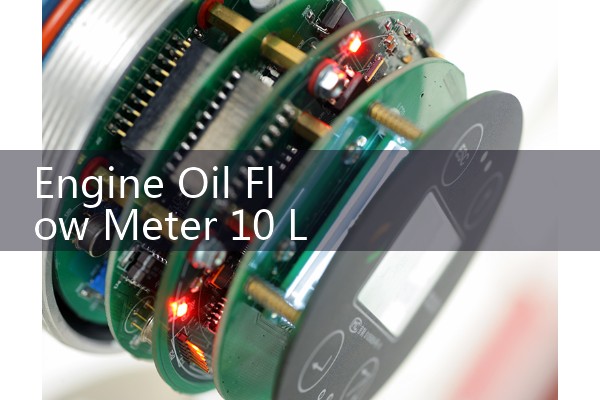
Silver Instruments recommends the oval gear flow meter series SGO. For 10 L/min engine oil we typically supply the DN10 model with a range of 0.5 to 15 L/min. The body is cast iron or 316 stainless steel. Gears are hardened steel or PPS for light oils. Bearings are tungsten carbide or graphite. The measuring principle is mechanical. A set of two oval gears rotate in tight mesh. Each rotation traps a precise pocket of oil between the gear and the chamber wall. A non contact Hall sensor or a reed switch picks up the rotation and converts it to a pulse or a 4-20 mA signal.
Because it is volumetric, viscosity does not change the trapped volume. At 10 L/min with a 150 cP oil the meter repeats within 0.2 percent. Our factory calibration uses ISO 17025 traceable oil at 30 cSt to match real engine oil conditions. You can also get a meter with a built in PT100 temperature sensor and a local display showing liters per minute and total liters. Output options include 4-20 mA HART, pulse, or RS485 Modbus. Thread sizes are NPT 1/2 inch or G1/2. Maximum working pressure is 40 bar and maximum temperature 120 degrees Celsius. For a marine engine room in Southeast Asia this works very well.
A Real Site in a Vietnam Lube Oil Blending Plant
Last year a customer in Ho Chi Minh City asked us for a flow meter to monitor base oil dosing into small blending tanks. The flow was 6 to 12 L/min. The oil grade was SAE 30, viscosity around 200 cP at the filling temperature. They had tried a small inline turbine meter but the reading dropped to nearly zero below 8 L/min. We supplied a Silver Instruments DN10 oval gear meter with a pulse output connected to their PLC. The pulse scaling was
In practice, the installation is straightforward. The oval gear meter needs a small inline strainer, 200 mesh, because engine oil can carry swarf. We always ship a Y type strainer with the meter. The pipes should be DN10 or DN15 and free of air pockets. A pulse damper upstream, such as a small diaphragm accumulator, smooths out the piston pump pulses common in lube oil circuits.
What Data You Need to Send Us for a Quote
If you measure engine oil at 10 L/min and face viscosity resistance, send us these six numbers. We will select the right oval gear meter and send a formal quote within one working day. Please provide the oil type and approximate viscosity in cP or cSt, the minimum and maximum flow rate in L/min, the operating pressure in bar, the temperature in degrees Celsius, the pipe size in DN, and the required output such as 4-20 mA HART or pulse. Also tell us if you need an ATEX Zone 1 certification for blending rooms. Email this data to our team or fill the inquiry form on the engine oil flow meter page. We ship to Kuala Lumpur, Jakarta, Dubai, Santiago, Lagos, and forty other cities without delay.
FAQ on Engine Oil Flow Measurement
Q: Can a turbine flow meter measure engine oil at 10 L/min?
A: Almost never. Even a small DN6 turbine requires a higher linear velocity and clean, low viscosity fluid. When the oil is thicker than 30 cP and flow dips below the transition zone, the meter output becomes non linear. You will get a reading but it will not be accurate enough for batching or process control.
Q: What is the lowest flow rate the oval gear meter can measure?
A: The DN10 model from Silver Instruments reliably measures down to 0.5 L/min for oil up to 1000 cP. Below that, a smaller DN6 version covers 0.1 to 3 L/min. For extremely viscous oils above 3000 cP we move to a rotary piston flow meter.
Q: Does a change in oil viscosity shift the calibration?
A: No, not with a true positive displacement meter. The oval gear pockets sweep a fixed volume per revolution. Viscosity only changes the internal leakage slightly. With proper clearance design, the shift from 10 cP to 500 cP stays well within the meter accuracy class of 0.5 percent.
Q: Can I get a local display and 4-20 mA HART output?
A: Yes. Silver Instruments builds the SGO series with a compact local indicator that rotates 350 degrees for reading. The electronics output a loop powered 4-20 mA signal with HART protocol. You can read instantaneous flow and totalized volume from the PLC and the field display at the same time.
Q: Are the wetted parts compatible with synthetic engine oils?
A: Standard wetted parts are cast iron housing, steel gears, and FKM or PTFE seals. This works for mineral based and most synthetic engine oils. For aggressive ester based racing oils we substitute 316 stainless steel housing and PPS gears with PTFE seals. Just mention the oil formulation when you inquire.
Send your oil parameters today. We size the correct 10 L/min engine oil flow meter so you do not fight viscosity resistance again. Silver Automation Instruments serves over 60 countries with oval gear, Coriolis, electromagnetic, and ultrasonic flow meters. For immediate support, reach our engineers directly from the contact page on flow-meter.com.au.
 Hot Blog
 Related AD