

『Eyewash Flow Meter Testing Checklist: Ensuring OSHA Compliance and Minimum Flow Rates』Related information(clamp on meter|electromagnetic meter|venturi meterrotameter|orifice meter|ultrasonic flow meter|mass flow meter|coriolis mass flow meter|coriolis flow meter|magnetic flow meter|magmeter flow meter|magflow flow meter|mag meter flow meter|electromagnetic flow meter|vortex flow meter|turbine flow meter|thermal mass flow meter|thermal flow meter|rotameter flow meter)
Eyewash Flow Meter Testing Checklist: OSHA Compliance and Minimum Flow Rates
Quick Answer: OSHA requires emergency eyewash and safety shower stations to meet ANSI/ISEA Z358.1 minimum flow rates. An eyewash must deliver 1.5 L/min, an eye and face wash 11.4 L/min, and a drench shower 75.7 L/min for 15 minutes. Use a calibrated flow meter every week and during the annual test to verify these rates and document the results.
What OSHA and ANSI Z358.1 Say About Eyewash Flow
OSHA standard 29 CFR 1910.151(c) states that employers must provide suitable facilities for quick flushing of eyes and body. The standard itself does not list exact flow figures. Inspectors usually refer to ANSI/ISEA Z358.1 for the numbers that matter.
ANSI/ISEA Z358.1 requires three minimum flow rates. An eyewash unit needs 1.5 liters per minute at 210 kPa. An eye and face wash needs 11.4 liters per minute. A drench shower needs 75.7 liters per minute. Each unit must run for a full 15 minutes with steady flow. That is the part most maintenance teams miss.
Water temperature matters too. The ANSI standard sets a safe range of 16 to 38 degrees Celsius. Below 16 degrees Celsius a worker will not stay in the shower for 15 minutes. Above 38 degrees Celsius the heat can worsen chemical burns. A PT100 temperature sensor on the supply line gives you a direct record of water temperature during the test.
Weekly Eyewash Flow Meter Test Checklist
ANSI requires a weekly activation test for all eyewash and eye and face wash units. Safety showers need a weekly visual check plus an annual full flow test. The weekly run clears sediment and verifies that water reaches the nozzles. But activation alone is not enough.
Use this checklist for each unit on your site.
1. Check access to the station. No pallets, drums, or racks within 1 meter.
2. Remove nozzle caps and inspect them for damage or blockage.
3. Activate the unit and let it run long enough to clear sediment. In practice 30 to 60 seconds works for most clean systems.
4. Measure the steady flow with a calibrated flow meter. Compare the value to 1.5 L/min, 11.4 L/min, or 75.7 L/min depending on the unit type.
5. Check the spray pattern. It should cover the eyes or the full body as designed.
6. Record the date, tester name, flow rate, water temperature, and any corrective action on the station log.
Most engineers skip the flow meter step. They open the valve, see water, and close it. We have seen this on customer sites many times. A clogged nozzle can still pass a visual check but fail the minimum flow by a wide margin.
Annual Full Flow Test and Documentation
Once per year you need a full 15 minute flow test on every eyewash, eye and face wash, and drench shower. This test checks the entire water supply path under sustained load. Pressure drops, rust particles, and undersized pipe are more visible over 15 minutes.
Use a flow meter with data logging or connect the meter to a paperless recorder. A 4-20 mA HART output from an electromagnetic flow meter works well here. The recorder stores flow values every second. If the flow drops below the minimum at minute 12, you have the data to prove it.
Here is the thing. A customer in Vietnam skipped the annual test and only did 10 second weekly checks. Three units failed during an audit because the flow dropped after 3 minutes. The supply line had a partially closed valve. A 15 minute test with a flow meter would have found this in the first year.
Keep annual test records for at least two years. Some safety managers keep five years. Documentation should include meter calibration date, flow rate in liters per minute, water temperature in degrees Celsius, and test duration.
Choosing the Right Flow Meter for Eyewash Testing
Not every flow meter fits eyewash testing. The flow rates are low. The test is short. The meter must handle clean water at 16 to 38 degrees Celsius and give a fast reading.
A portable clamp-on ultras
_600x400.jpg)
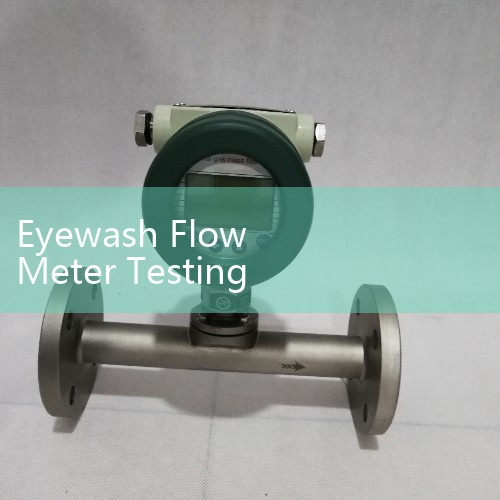
An inline electromagnetic flow meter is a better permanent choice. A DN15 or DN20 electromagnetic flow meter measures from 0.1 to 10 meters per second. It has no moving parts. Output options include 4-20 mA HART, pulse, and RS485. For a drench shower loop, a DN25 or DN32 electromagnetic flow meter covers 75.7 L/min easily.
A vortex flow meter works for larger drench shower supply headers. It needs a minimum flow velocity to operate. Check the Reynolds number before you size it. An oval gear flow meter can measure low flow with high accuracy but works only with clean water. Avoid thermal mass flow meters for this job. They are made for gas, not liquid eyewash testing.
We recommend a Silver Instruments electromagnetic flow meter for permanent eyewash and drench shower monitoring. For portable checks, ask about our portable ultrasonic flow meter.
Common Mistakes in Eyewash Flow Testing
One common mistake is measuring flow at the wrong pressure. ANSI Z358.1 uses 210 kPa or 30 psi. If your supply pressure is lower, the flow rate will fail even with clean nozzles. Install a pressure gauge next to the test valve and record the value.
Another mistake is measuring only one unit on a shared line. Large sites often feed multiple safety showers from one header. Flow to the last unit can drop when upstream units open. Test each unit at the same time if they share a line.
We saw this at a paint manufacturer in Southeast Asia. Four showers shared a 50 mm header. The last shower passed at 80 L/min when tested alone. It dropped to 58 L/min when all four ran together. That is below the 75.7 L/min minimum.
Because regulatory fines are only part of the risk, a failed eyewash can cause serious injury. Use a flow meter and test the real site conditions.
Silver Instruments Flow Meters for Eyewash Testing
Silver Automation Instruments supplies electromagnetic flow meters, portable ultrasonic flow meters, vortex flow meters, oval gear flow meters, and paperless recorders. Our meters work for water and wastewater, chemical, food and beverage, and marine applications.
For eyewash compliance work we often quote a DN15 electromagnetic flow meter with 4-20 mA HART output, PTFE liner, and local display. The 4-20 mA HART output connects to a paperless recorder or PLC. The local display lets a technician read the flow rate without opening a panel.
Send us your pressure in bar, temperature in degrees Celsius, pipe size in DN, and flow range. We will quote a suitable meter. Contact Silver Automation Instruments.
Tel: +86-25-68650347
Whatsapp: +86-25-52155837
WeChat: +86 15365082610
FAQ: Eyewash Flow Meter Testing
What minimum flow rate does OSHA require for an eyewash station?
OSHA references ANSI/ISEA Z358.1. The minimum flow is 1.5 L/min for an eyewash unit, 11.4 L/min for an eye and face wash, and 75.7 L/min for a drench shower.
How often should I test eyewash flow rates?
Activate eyewash units weekly and measure flow. Conduct a full 15 minute annual test on every eyewash, eye and face wash, and drench shower.
Which flow meter type is best for eyewash testing?
A portable clamp-on ultrasonic flow meter works well for quick checks. A DN15 or DN20 electromagnetic flow meter is better for permanent monitoring and data logging.
What pressure is required for ANSI Z358.1 eyewash testing?
The standard uses 210 kPa or 30 psi. Check supply pressure during the test because low pressure is a common cause of flow failure.
Can I use a thermal mass flow meter for eyewash water flow?
No. Thermal mass flow meters are designed for gas. Use an electromagnetic, ultrasonic, vortex, or oval gear flow meter for liquid eyewash testing.
 Hot Product
 Related AD