

『Refrigerant Flow Meter for Supermarket Refrigeration: Managing Multi-Deck In-Line Feeds』Related information(clamp on meter|electromagnetic meter|venturi meterrotameter|orifice meter|ultrasonic flow meter|mass flow meter|coriolis mass flow meter|coriolis flow meter|magnetic flow meter|magmeter flow meter|magflow flow meter|mag meter flow meter|electromagnetic flow meter|vortex flow meter|turbine flow meter|thermal mass flow meter|thermal flow meter|rotameter flow meter)
Refrigerant Flow Meter for Supermarket Refrigeration: Managing Multi-Deck In-Line Feeds
Quick Answer: A Coriolis mass flow meter measures refrigerant mass flow, density, and temperature directly in liquid lines feeding multi-deck display cases. This data helps detect leaks under 0.5 kg/year, balance evaporator loads, and protect compressors from liquid slugging. Use a meter with 4-20 mA HART output and ATEX Zone 2 certification for typical R404A or CO2 booster systems.
Why Direct Mass Flow Measurement Works Better
Engineers who manage supermarket racks know that volumetric flow meters misread refrigerant when density shifts. A sight glass tells you about bubbles but not the real mass flow into each case. Coriolis meters bypass this problem. They measure mass directly in kg/h or lb/min. When a multi-deck lineup has 12 evaporators on one liquid header, a single Coriolis meter on the main feed sees the total refrigerant mass. Branch imbalance shows up as a gradual drop from the expected total. That catches your eye before case temperature alarms go off.
Temperature and density outputs come free with the mass flow signal. For a rack running R134a at +25 °C liquid temperature, density should sit around 1160 kg/m³. A drift toward 1100 kg/m³ often means air or non-condensables have entered the system. We have seen this on a customer site in Thailand where a slow condenser fan failure led to a 4 percent density shift over six weeks. The maintenance team got the alert and fixed the fan before it tripped the high-pressure cutout.
Where to Install the Flow Meter on a Multi-Deck Feed
The best spot is the main liquid line after the receiver, just before the distribution header that splits off to individual case tees. Pipe sizes are usually DN15, DN20, or DN25 depending on total case load. A typical 30-meter lineup of open dairy decks might run at 300 kg/h peak with R404A. Install the meter in a straight pipe section with 10D upstream and 5D downstream if possible. If you need to measure individual branch lines, small inline Coriolis meters with process connections down to 1/4 inch NPT fit directly into the copper line.
Avoid placing the meter right after a filter drier or solenoid valve. Rapid pressure drops can cause temporary two-phase froth that fools some meter types. Coriolis meters tolerate up to 10 percent gas volume fraction in the liquid without losing accuracy much, but you still want a column of subcooled liquid. Subcooling of 5 K is common. That gives you a stable signal.
Why a Coriolis Meter Beats Other Technologies Here
Thermal mass flow meters drift when oil circulates with the refrigerant. Vortex meters require a minimum Reynolds number that low-load night operation might not hit. Ultrasonic clamp-on meters struggle with thin copper walls and coating. Oval gear meters work but drop pressure and risk oil sticking. In practice, most supermarket engineering consultants we talk to in the Middle East and Australia prefer Coriolis because it gives mass flow, density, and temperature in one compact spool piece with no moving parts in the flow stream.
Pressure drop
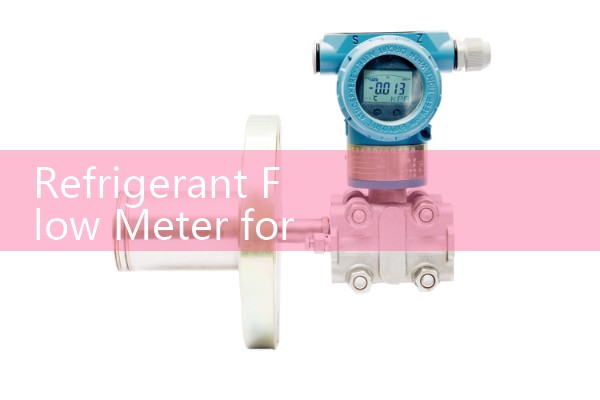
Silver Instruments Coriolis Flow Meter for Refrigerant Lines
Silver Automation Instruments supplies a dedicated refrigerant-grade Coriolis meter, model series SIL-COR-R. Sizes go from DN06 to DN25 with stainless steel 316L wetted parts and JIS or ANSI flange options. The transmitter outputs mass flow, density, and temperature via 4-20 mA HART, Modbus RTU, or pulse. ATEX Zone 2 and Zone 1 enclosures are available for racks placed in machinery rooms. Accuracy is ±0.1 percent of rate for liquids, with repeatability better than ±0.05 percent. Density accuracy of ±0.5 kg/m³ helps spot non-condensable buildup early.
For a supermarket chain in Vietnam, we configured a DN15 SIL-COR-R meter on the main liquid line of a low-temperature R404A rack serving 14 island freezers. The meter runs at 38 bar and -20 °C suction conditions (liquid line at +30 °C). Every 24 hours the building management system pulls an average mass flow and compares it to the design value. A drift of more than 3 percent triggers an automatic leak check. In 14 months of operation the site identified three slow leaks and saved an estimated 110 kg of refrigerant that would have been lost before the next scheduled maintenance.
FAQ
Q: Can a Coriolis meter measure two-phase refrigerant mixture?
It is not recommended. The meter needs mostly liquid. Gas pockets increase measurement noise. Keep subcooling above 3 K. If two-phase flow is unavoidable, an upstream separator is required.
Q: What output signals does the meter offer?
Standard is 4-20 mA HART with Modbus RTU. Optional outputs include pulse, frequency, or a second 4-20 mA channel. Silver Instruments can supply M12 or cable gland connections per your spec.
Q: Does the meter require yearly recalibration?
Coriolis meters hold calibration well. We recommend a zero-point check every 12 months under no-flow conditions. Physical recalibration is needed only if you see a zero drift beyond 0.015 percent of full scale.
Q: What is the typical lead time for a DN15 SIL-COR-R with ATEX?
Standard models ship in 2 to 3 weeks. ATEX Zone 1 units usually add 1 week for documentation review. Express shipping to Australia, Singapore, or UAE takes 5 to 7 days.
Q: Can this flow meter handle CO2 transcritical pressures?
Yes. The standard pressure rating is PN100 (100 bar) for CO2 applications. We also offer a PN130 version for safety margins on high-ambient sites in the Gulf region.
Ask for a Quote
Tell us your refrigerant type (R404A, R134a, R744, etc.), operating pressure in bar, liquid temperature in °C, pipe size (DN), and the flow range in kg/h. We will recommend the right SIL-COR-R model and send you a quotation with a datasheet.
Email: [email protected]
Tel: +86-25-68650347
WhatsApp: +86-25-52155837
WeChat: +86 15365082610
Visit: https://flow-meter.com.au for more refrigerant flow meter options.
 Hot Product
 Related AD