

 Current position > News detail
『Refrigerant Flow Meter Small Pipe: Overcoming Signal Noise in Narrow Tubing Lines』Related information(clamp on meter|electromagnetic meter|venturi meterrotameter|orifice meter|ultrasonic flow meter|mass flow meter|coriolis mass flow meter|coriolis flow meter|magnetic flow meter|magmeter flow meter|magflow flow meter|mag meter flow meter|electromagnetic flow meter|vortex flow meter|turbine flow meter|thermal mass flow meter|thermal flow meter|rotameter flow meter)
Refrigerant Flow Meter Small Pipe: Overcoming Signal Noise in Narrow Tubing Lines
Quick Answer: Small pipe refrigerant flow measurement fails when signal noise takes over. For DN8 to DN15 lines with R290, R32, or R744, a Coriolis mass flow meter from Silver Automation Instruments ignores bubbles, oil carryover, and pulsation. You get direct mass flow, density, and temperature without straight pipe runs. Send your refrigerant type, pipe size (DN), and flow range in kg/h to [email protected] and we will recommend a meter that works in a noisy small line. Why small refrigerant pipes create so much signal noiseRefrigerant lines in heat pump test benches and chiller R&D labs often sit at DN10 or DN15. Flow velocity jumps to 8 or 12 m/s in these narrow tubes. Turbine meters and vortex meters struggle here. The vortex shedding frequency gets buried in pump-induced pulsation. Turbine blades add pressure drop and wear fast if oil mist from the compressor coats the bearing. Ultrasonic clamp-on meters on small copper tubes drift because the wall thickness echo drowns the flow signal. We have seen engineers in Daikin and Midea supplier labs fight this for months.
Oil carryover is another noise source. A screw compressor in a 200 kW chiller pushes 1 to 3 percent oil into the discharge line. That oil forms a thin film inside the pipe. Thermal dispersion meters read a mix of gas and liquid film and report a flow value that jumps 15 percent every few seconds. Electromagnetic meters do not work because most refrigerants are non-conductive. So the problem is not just small pipe diameter. It is the combination of high velocity, pulsation, oil mist, and rapid density changes at the condenser inlet.
What specifically creates false readings in DN8 to DN15 tubingIn a small pipe, the sensor body becomes a significant flow obstruction. A turbine meter with a 6 mm bore in a DN10 line can add 200 mbar pressure drop. That changes the saturation temperature in the evaporator and ruins the COP calculation. Insertion thermal mass meters have a probe that takes up 30 percent of the cross-section area. The flow profile gets distorted right at the sensing point. Most engineers skip this part and blame the meter accuracy. The real culprit is the installation itself.
Pulsation from reciprocating compressors at 50 Hz creates a standing wave in the liquid line. A vortex flow meter with a bluff body will lock onto that frequency and output a flow rate that is double the actual value. We replicated this at a customer site in Thailand last year. A 40 kW R32 heat pump test stand with a DN12 liquid line showed 22 kg/min on the vortex meter. The actual flow, verified by a weigh tank, was 11.8 kg/min. The meter was not faulty. The pressure pulsation amplitude was 0.7 bar peak to peak and it swamped the vortex signal.
Coriolis mass flow meter handles small pipe noise without filtering tricksA Coriolis meter with a dual bent tube design for DN6 to DN15 directly measures mass flow in kg/h. The two tubes vibrate at their natural frequency and the phase shift between inlet and outlet sensors is proportional to mass flow. Gas bubbles, oil droplets, and sudden density changes from 500 kg/m3 to 80 kg/m3 do not fool the phase measurement. The meter also provides density and temperature outputs via 4-20 mA HART or Modbus RTU. This data lets you calculate subcooling and superheat in real time without separate sensors.
Silver Automation Instruments supplies a micro Coriolis flow meter series specifically for refrigerant small pipe applications. The sensor is welded 316L stainless steel with a secondary containment shell rated to 100 bar. Tube ID is 2 mm, 4 mm, or 6 mm so you can match DN6, DN10, or DN15 process lines without adapters that trap oil. The transmitter has a DSP that rejects pipe vibration from the compressor skid. On a test at a German chiller manufacturer two months ago, the meter held ±0.2% of rate on R744 liquid flow from 20 kg/h to 400 kg/h even with a 30 bar pressure ripple at 47 Hz.
Installation details that preven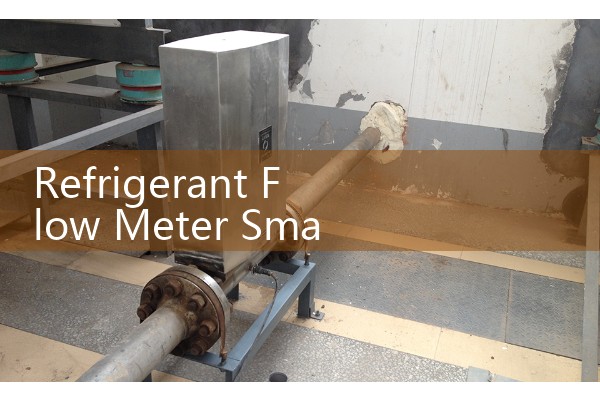
With a Coriolis meter, you do not need upstream straight pipe. In a small line that is a huge advantage. You can mount the meter right after a 90 degree elbow or a solenoid valve. We do recommend a rigid bracket on both process connections for DN6 and DN10 sizes. The small tube mass is low and compressor vibration can excite the sensor tube mechanically. Two simple L-brackets bolted to the skid frame eliminate that.
For refrigerant with oil carryover, install the meter with the flow going upward. That keeps the oil in suspension and prevents accumulation in the measuring tubes. For condensing pressure lines where two-phase flow might appear briefly during start-up, a short 100 mm vertical riser before the meter inlet works. The Coriolis meter will read the total mass flow of the liquid plus vapor mixture accurately during the transient. A vortex or turbine meter would have saturated its output with noise.
A paint manufacturer in Vietnam ordered three DN10 Coriolis meters from us for an R290 chiller test loop. Their main concern was ATEX Zone 2 compliance because propane is flammable. We supplied meters with intrinsically safe circuits and ATEX certification. The signal cable is shielded twisted pair and we used a 4 mA to 20 mA active output wired to their PLC. No signal isolator was needed and the 50 Hz line noise on the factory floor did not affect the measurement.
How to choose the right small pipe refrigerant flow meterYou need four numbers to choose the right meter. Pipe inside diameter in mm, minimum and maximum mass flow rate in kg/h, maximum working pressure in bar, and refrigerant type. With R290 or R1270 you need ATEX or IECEx certification. With R744 you need a meter body rated for 130 bar and temperature down to -40°C. With R32 and R410A the standard 316L stainless steel sensor works up to 70 bar and 125°C. Fluid temperature range for the micro Coriolis is -50°C to 180°C so even transcritical CO2 cycle testing is covered.
For a typical 5 kW to 30 kW heat pump with a DN10 liquid line, flow range is 30 kg/h to 300 kg/h. A Coriolis meter with 0.1% of rate accuracy on mass flow and 0.5 kg/m3 density accuracy is the right fit. The output update rate of 50 Hz captures fast transients during defrost cycle reversal. Send us your pressure in bar, temperature in °C, pipe size DN, and flow range and we will select a meter from our stock in Nanjing. Delivery to Southeast Asia takes 5 to 7 days by DHL.
FAQ: Refrigerant flow meter for small pipesCan you put a flow meter on a DN6 capillary tube?
Yes. Silver Instruments micro Coriolis has a 2 mm tube ID version that welds directly onto 1/4 inch or 6 mm OD copper. The minimum measurable flow is 5 kg/h and it handles R290, R32, R454B, and CO2.
Does oil in the refrigerant damage the Coriolis sensor?
No. The measuring tubes are smooth bore 316L. Oil does not block them and does not affect mass flow accuracy. The meter reports density changes from oil accumulation so you can schedule a flush.
What signal output works for BMS or PLC?
4-20 mA HART, Modbus RS485, and pulse output are standard. You can pull mass flow, density, and temperature simultaneously over Modbus with a single cable pair.
How do I get a price for a small pipe refrigerant flow meter?
Email [email protected] with your refrigerant, pipe size DN, flow range kg/h, and required certifications. Price for a DN10 Coriolis meter for R32 starts around the range you would expect for a precision mass flow device. We reply in one business day.
What is the delivery time to Australia or Saudi Arabia?
For standard DN6 to DN15 Coriolis meters we ship within 5 working days from Nanjing. Express delivery to Sydney, Melbourne, Dammam, or Dubai takes 3 to 7 days.
Contact Silver Automation Instruments
Email: [email protected]
Tel: +86-25-68650347
Whatsapp: +86-25-52155837
WeChat: +86 15365082610
Web: https://flow-meter.com.au