

 Current position > News detail
『HFC Refrigerant Flow Meter: Phase Change Management and Environmental Reporting Metrics』Related information(clamp on meter|electromagnetic meter|venturi meterrotameter|orifice meter|ultrasonic flow meter|mass flow meter|coriolis mass flow meter|coriolis flow meter|magnetic flow meter|magmeter flow meter|magflow flow meter|mag meter flow meter|electromagnetic flow meter|vortex flow meter|turbine flow meter|thermal mass flow meter|thermal flow meter|rotameter flow meter)

HFC Refrigerant Flow Meter: Phase Change Management and Environmental Reporting Metrics
Quick Answer: A Coriolis mass flow meter directly measures the mass of liquid and vapor HFC refrigerant even during phase change. This eliminates the guesswork in charging, recovery, and leak detection. The meter also provides continuous density and mass flow data, which are the exact metrics required for F‑gas environmental reporting.
Most engineers start with a turbine or vortex meter and then realize the problem. HFC refrigerants like R‑410A and R‑134a flash into vapor the moment pressure drops across the flow element. A Coriolis meter does not care. It reads the true mass flow regardless of whether the flow is liquid, gas, or a churn of both. We have seen this on customer sites many times. A cold room installer in Malaysia swapped a DP meter for a Silver Instruments SIL‑CMF015 and their charge error dropped from 8 percent to below 0.5 percent.
Phase Change Is the Real Measurement Problem
Refrigerant lines are rarely single‑phase. The flow can be subcooled liquid for a few seconds, then a wet vapor mixture as the compressor starts. A velocity‑based meter like a turbine will overread when gas bubbles pass through. A thermal mass meter calibrated for gas will lose all meaning when liquid slugs hit the sensor. A Coriolis meter measures inertia. Liquid, vapor, and two‑phase mixtures all contribute to the mass flow signal proportionally. The meter also picks up density in real time, so you can see the phase change happening as the density number drops from 1200 kg/m³ to under 100 kg/m³.
Because the meter is immune to phase change, you can place it right at the charging port or on the liquid line upstream of the expansion valve. In a recent job for a Vietnamese reefer container repair yard, we put a SIL‑CMF025 on the R‑134a charging skid. The operator wanted a meter that would not cavitate. The Coriolis works with a back pressure of just 2 bar downstream, and it still delivered stable mass flow readings within ±0.15 percent of rate.
Why a Coriolis Meter Simplifies HFC Measurement
A Coriolis meter eliminates the need for separate pressure and temperature transmitters that a DP or vortex setup would demand. It gives you mass flow, density, and temperature from one device. The standard output from Silver Instruments Coriolis meters includes 4‑20 mA HART, pulse, and Modbus RTU. You wire one instrument and you have all the data a PLC or energy management system needs.
Here is a common field scenario. A chemical blending plant in Thailand makes polyol pre‑blends and needs to dose R‑245fa as a blowing agent. The flow range is tight, from 30 to 300 kg/h. They first tried a small oval gear meter, but the low viscosity of the liquid refrigerant caused internal slip and an error of almost 4 percent. They switched to a SIL‑CMF010 with DN10 connections and a Hastelloy wetted path. The meter measures directly in kg/h and ignores viscosity changes. The plant now uses the same meter signal to control the dosing valve and to log the daily refrigerant consumption for their sustainability report.
Environmental Reporting Metrics Without Extra Instruments
F‑gas regulations in Australia, Singapore, and the Middle East require accurate refrigerant usage logs. The key metrics are total mass charged, total mass recovered, and leakage rate expre
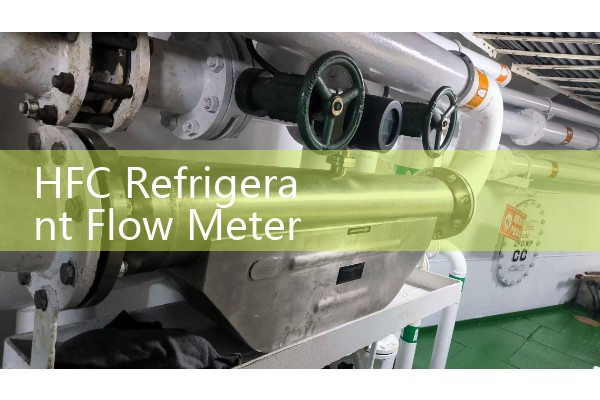
For a district cooling plant in Jeddah, we integrated a SIL‑CMF040 meter with a remote display and a Paperless Recorder. The operator runs an R‑134a inventory report every shift. The report pulls start and end mass totals from the meter, subtracts them, and generates a formatted PDF. This setup passed a third‑party environmental audit without any post‑processing fudge factors. The auditor simply verified the meter serial number and the factory calibration certificate traceable to NIST.
Selecting the Right Meter for Your HFC Refrigerant
The pipe size usually dictates the meter model. For small charging stations and lab test benches, the SIL‑CMF010 and SIL‑CMF015 cover DN10 to DN15. Flow ranges are 0 to 600 kg/h for common HFC blends with a standard accuracy of ±0.15 percent of rate and density accuracy of ±0.5 kg/m³. For larger chillers and containerized reefer racks, the SIL‑CMF025 and SIL‑CMF040 handle DN25 to DN40 and up to 6000 kg/h. The wetted parts are stainless steel 316L, which works with HFCs, and we offer Hastelloy for refrigerant blends that carry trace acids.
The process connection options include tri‑clamp, flanged, and NPT, so you can match the existing pipe spec without extra welding. If the installation is outdoors in Saudi Arabia or Western Australia, specify the IP67 transmitter housing and the sunshade. In a free‑drain recovery setup, you can put the meter on the vapor line, because the Coriolis does not need full pipe flow. It measures mass even with pockets of gas.
FAQ
Can a Coriolis meter handle refrigerant with vapor bubbles? Yes. The Coriolis principle measures mass directly, so a mixed phase does not cause the large errors you see with turbine or ultrasonic meters. You get a reliable mass flow reading even during two‑phase flow.
What signals do I get for an F‑gas reporting system? Standard outputs are 4‑20 mA HART for mass flow, a pulse output for totalizing, and Modbus RTU for density, temperature, and flow rate. All values go directly into a PLC or environmental data logger.
Do I need a straight pipe run? No. Coriolis meters are not sensitive to flow profile. You can install them right after an elbow or a ball valve. That saves space on a charging panel.
Which refrigerant types does Silver Instruments support? R‑134a, R‑410A, R‑32, R‑404A, R‑407C, R‑449A, R‑513A, and many other HFC and HFO blends. Wetted materials are compatible with most common refrigerants and their POE oils.
What is the typical delivery time for a small meter like the SIL‑CMF015? Ex‑stock for standard 316L models with NPT connections. Configured meters with special process connections or Hastelloy ship within two weeks from our Nanjing factory.
To get a written quotation, send us your refrigerant type, operating pressure in bar, temperature in °C, pipe size (DN), and the flow range in kg/h. Email [email protected], call +86-25-68650347, or send a message via WhatsApp at +86-25-52155837. Our engineers will propose the exact meter model and process connection within one working day.